File photo
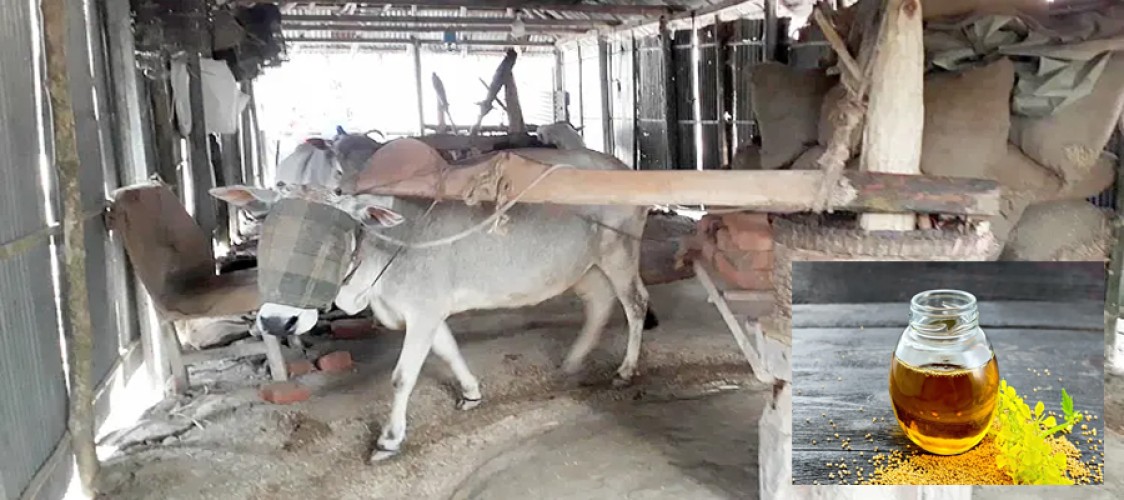
Advertisements mention mustard oil extracted from ghani. But most of the current generation is unfamiliar with ghani. However, even two decades ago, ghani could be found in villages. The oil obtained from this old method of processing was the best in terms of quality and purity.
Wooden ghani is also known as oil tree in some parts of the country. People involved in this profession are known as kalu or telir. However, since the process of extracting oil from ghani is time-consuming, it is now on the verge of extinction, struggling to compete with modern machines. People from the kalu community are forced to change their profession.
However, some still hold on to their ancestral profession with love. Two such kalu can be found in Chirirbandar upazila of Dinajpur. They are Md. Azizar Rahman and Shafiqul Islam. They have been involved in this profession for generations. Azizar Rahman said that there are three ghani or oil trees in the house. His father and grandfather were oil workers. He inherited this profession from his father Abdul Shah.
These three oil mills operate throughout the year. Oil is sold on Fridays and Tuesdays at the nearby Binnakuri market. Besides, people from different areas come to their homes every day to buy oil. In winter, everyone, young and old, applies mustard oil on their bodies, so the demand increases. Sales are also high.
Azizar also said that since the price of oil made from wooden ghani is relatively high, there are few buyers. But its buyers mainly prioritize purity. Another oil miller in the area is Md. Shafiqul Islam. The 30-year-old man's grandfather Nasirat was a famous oil miller in the area. His father Abdus Samad was also in the same profession. Shafiqul took over after his father's death five years ago.
According to him, people are being forced to leave the profession due to the inability to keep up with technology and the increase in the price of mustard and cow fodder. However, many buyers still look for 100% pure mustard oil made from wooden ghani without calculating the profit and loss. That is why a few oil millers are still maintaining the profession of their ancestors.
Once upon a time, pure mustard oil was sold in clay pots in village markets. Under the lid of the pot was a bamboo handle made of palm kernel shell. This utensil was used to pour the oil.
The main reason behind the disappearance of the profession is modern technology. Today's traders sell oil produced in iron pots with electric motors at a lower price. But in comparison, the price of pure mustard oil, extracted drop by drop by day and night in old-fashioned pots, is naturally higher. This unequal competition is the main obstacle for the Kalus.
A large part of the buyers of the mustard oil from the pots in Chirirbandar are expatriates. They buy this oil when they come home or collect it through relatives. This oil is sold for 260 to 280 taka per kg. The history of the Kalus community of Jotramdhanpur village is hundreds of years old. The surviving Kalu family has been in this business for 60-65 years, with two generations in succession.
You can learn about South Asia's largest exhibition on this
topic through this link: https://oilsfatsasia.com/
Source: Online/OFA























Copyright © 2026 LIMRA Exhibitions. All Rights Reserved.
Website Design & Development ♡ MY SOFT IT
 EN
EN
 Chinese
 Turkish
 Indonesian
 German
 French
 Spanish
 Portuguese
 Russian
 Italian